
Pharmaceutical materials warehousing · Cheb
Pharmaceutical Raw Material, API and Packaging Warehousing
Inter-Pharma assesses pharmaceutical starting-material and packaging projects separately from finished medicines. Supply chain, batch and status control, specifications, sampling interfaces, storage conditions and contamination risks are confirmed before acceptance.
Discuss your project →✓Own warehouse processes in Cheb
✓Batch, quarantine and release status
✓APIs and excipients assessed by project
✓Primary and secondary packaging separated
Inter-Pharma expertise
Precise solutions for pharmaceutical requirements
Define the material and regulatory role
API, excipient, primary, printed or secondary packaging, origin, intended use, client and operator roles are documented before acceptance. A general GMP or GDP reference does not replace product qualification or required authorisation.
Apply the specific GDP framework for APIs
EU GDP guidance specifically covers distributors of active substances for human medicines. Supplier and customer, original labelling, batch, agreed certificates, storage and transport conditions and traceability are assessed separately from finished medicines.
Qualify excipients by risk
Material properties, supply chain, specification, temperature, humidity and contamination risks determine the storage concept. Release remains with the accountable quality function.
Separate primary, printed and secondary packaging
Product-contact and printed materials require stricter identity, status, protection and access controls than suitable secondary packaging. Item version, lot, supplier, release, damage and use status are maintained.
Control quarantine, release, rejection and sampling interfaces
Statuses are clearly segregated. Sampling, testing and release only occur within a confirmed role, premises and hygiene scope or are handed to the responsible quality-control function.
Translate specifications into storage controls
Temperature, humidity, light, closure integrity, cleaning, pests, odour, dust, cross-contamination, hazardous-material and security requirements determine segregation, monitoring and escalation.
Assess a Cheb materials project
We need material type, specification and safety data, supplier and origin, packaging, temperature and humidity, volumes, status model, sampling and release process, interfaces, recipients and start date before confirming capacity.
Official sources for materials and packaging
- EU GDP guidelines for active substances (2015/C 95/01) →
- EudraLex Volume 4 – EU GMP guide →
- EU GMP Chapter 3 – premises and equipment →
- EU GMP Chapter 4 – documentation →
- EU GMP Chapter 5 – production and material control →
Applicability depends on material, activity, role and authorisation scope. These sources establish requirements; they do not prove certification or acceptance capability for Inter-Pharma.
Central European location
Cheb: at the centre of European routes
Cheb lies in western Czechia, directly at the German border. The location connects Bavaria, Saxony, Austria and Poland with short access routes to Central and Eastern Europe.
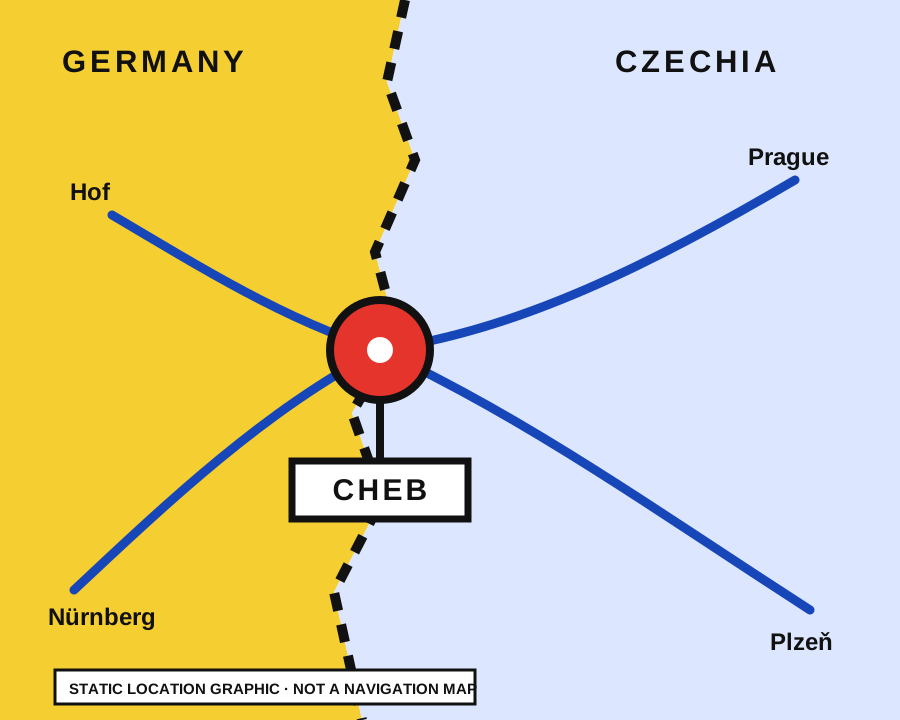
Distances from Cheb
Approximate straight-line distances, rounded to 10 km. Actual road distances vary by route.
Germany
Nürnberg≈ 120 km
Leipzig≈ 140 km
Dresden≈ 140 km
München≈ 220 km
Berlin≈ 280 km
Austria
Linz≈ 240 km
Salzburg≈ 260 km
Wien≈ 360 km
Poland
Wrocław≈ 350 km
Poznań≈ 410 km
Kraków≈ 540 km
Your project step by step
This is how we structure delivery. Before start, we agree which steps belong to us, the client or a partner.
Define products and volumes
Provide goods type, product status, temperature, SKU count, average and peak stock, movements, destinations and preferred start.
Deliverable: An agreed storage and service profile.
Agree quality and responsibilities
Together we define acceptance conditions, operator and client roles, authorisation scope, release decisions, deviation routes and required evidence.
Deliverable: Agreed scope and quality agreement.
Check and record incoming goods
Match goods and documents against the agreed receipt plan: item, quantity, batch, expiry, packaging and required temperature records. Unresolved goods remain blocked.
Deliverable: A documented receipt and clear stock status.
Put away and manage inventory
Assign accepted stock to its suitable area. Maintain traceable location, status, batch, expiry and movements; address replenishment and expiry risks as agreed.
Deliverable: Traceable inventory under the agreed temperature conditions.
Pick by batch and expiry
Select stock under the agreed FIFO or FEFO rules. Check item, batch, expiry and quantity before the next stage.
Deliverable: Checked order lines and updated inventory.
Hand over under control
Agree and record collection, handover point, stock status, quantities and required temperature information with the appointed carrier.
Deliverable: A documented handover and agreed status update.
Review performance and deviations
Compare stock, order status and agreed indicators. Follow deviations, causes, actions and owners through the agreed review cycle.
Deliverable: Traceable actions and updated planning.
What needs to be agreed before start?
Agree products, tasks, authorised contacts, evidence, data handovers and acceptance criteria. Dates and capacity follow the confirmed scope.
Your challenge deserves a precise solution.
We structure your needs and connect the right partners and processes.